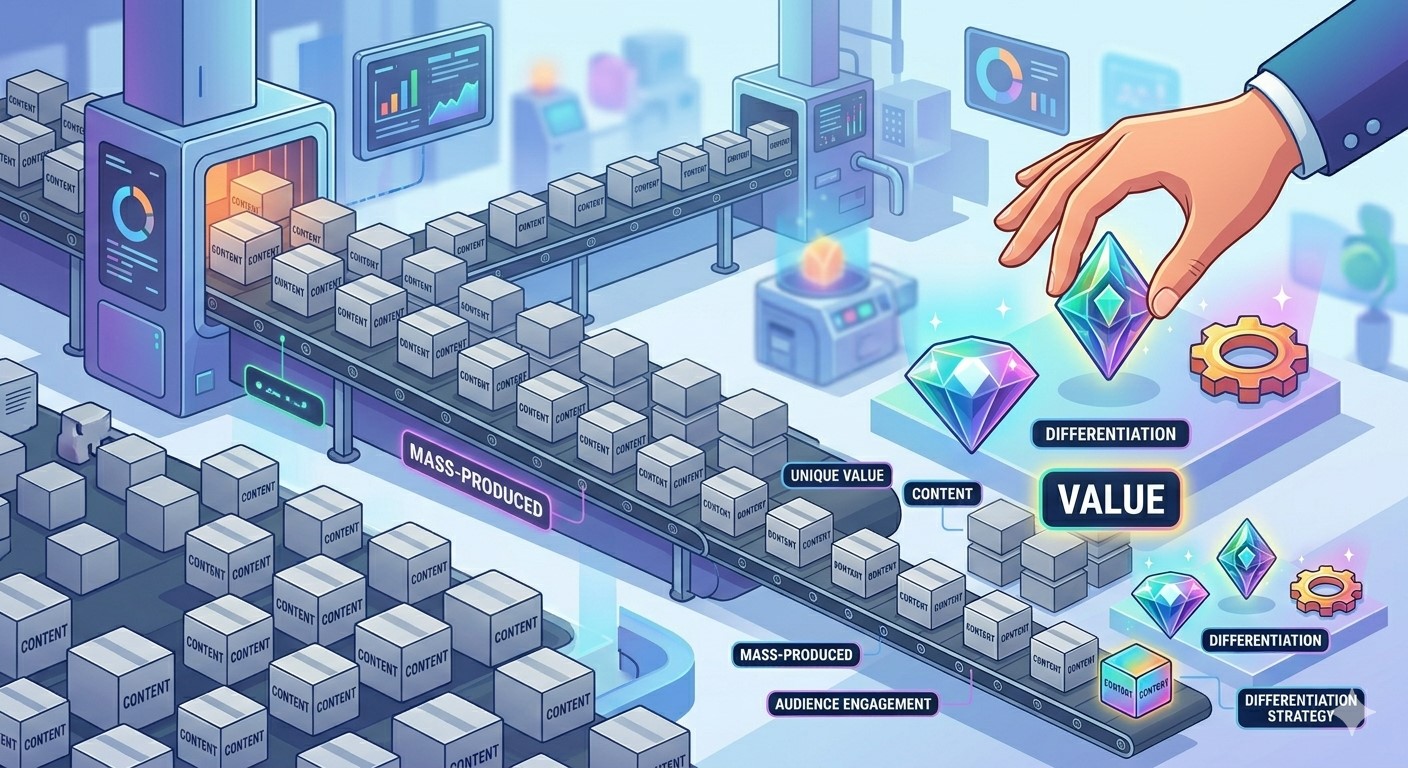
I’ve been doing SEO for over 25 years but I’d be the first to admit that I just can’t know everything, as much as I’d love to. So when Google released its AI Search guidance the other week there was a phrase I’d not seen before – “commodity content”. And of course I asked myself, what is commodity content?
But First, The Google AI Search Statement
The company’s first official guidance on optimising your website for generative AI features on Google Search was quite a broad piece, obviously focusing what we all need to do for AI Search in their environments. Not Bing, not ChatGPT, nor Claude, or Perplexity – All Google.
The mention of commodity content came under a section about applying foundational SEO best practices, in other words, nothing fancy, just do good SEO. Here’s the full quote of the section in question:
Creating non-commodity content that’s helpful, reliable, and people-first: Be sure that you’re writing non-commodity content that your readers will find helpful and reliable. Commodity content (for example, something like “7 Tips for First-Time Homebuyers”) is often based on common knowledge, which could originate from anyone, and typically adds little unique insight for readers. In contrast, non-commodity content (such as “Why We Waived the Inspection & Saved Money: A Look Inside the Sewer Line”) provides unique expert or experienced takes that go beyond common knowledge and the ordinary.
That’s so wonderfully Google; giving you more of an example than a definition. It’s why we’ve waited so long for the Mountain View giant to get up and guide. It took them over a year to crack down on generating content at scale, so why didn’t the AI optimisation surprise us? Were they sitting on the answer the whole time? Maybe they actually didn’t know! Or did they just get fed up with the endless speculation and the sheer and utter craziness of some of the real world guidance?
And What is Commodity Content then?
I’m making fun when I say Google didn’t define commodity content but then they didn’t dwell on it too much. So who better to ask than Google themselves, chiefly Gemini. This is what I prompted:
Hey Gemini, you’re a Google product, so what’s “Commodity content” as per recent guideline updates and what do they mean for website owners and SEOs?
First, I can’t believe I started the chat with “Hey”, that’s so unlike me, I try to keep the oh-so-British “hello” alive. But One digresses… here’s the answer…
The term “commodity content” has become a focal point in the SEO community following Google’s explicit guidance updates in May 2025 and recent clarifications by Google Search Liaison Danny Sullivan at Search Central events in April 2026.
Oh, I missed that. I started working for the Guildford digital marketing agency Air Social in May 2025, so I must have been distracted. But then Gemini continued:
In Google’s eyes, commodity content is generic, easily replicable information that lacks unique value. It is interchangeable; you could swap the branding on the article with a competitor’s, and the reader wouldn’t notice a difference.
Now that’s quite clear. Pull the sticker off and apply your own. That’s commodity content. White label, right?
Gemini then went on to point out the key characteristics of commodity content:
- Surface-level knowledge: It relies entirely on aggregated, common information (e.g., a generic listicle like “7 Tips for First-Time Home Buyers”).
- Zero original insight: It contains no proprietary data, first-hand experience, unique opinions, or original research.
- Easily automated: It is the exact type of content an AI could generate in 90 seconds using a basic prompt.
And that’s great. It almost makes me feel guilty for posting this as this article could have been written by anyone, right?
Commoditisation
I also looked up commoditisation, the root of it all, and the definition is the same but they went further, listing the process:
- Standardisation,
- Increased transparency,
- Race to the bottom.
Wow, how boring.
Understanding, Sharing, and Pondering
But the unique POV here is that, as an experienced SEO, I didn’t understand the term commodity content or commoditisation And I can’t justifiably speak to my clients without knowing. I’m the digital marketing expert so I should know shouldn’t I?
Then there’s the fact that my clients might not know themselves. I write down knowledge so that it has a place I can point to in a friendly environment. It’s good to share, and even to admit that you didn’t know.
To ruminate over the matter is vital – what on earth can you say on your website that is SO YOU? I advise all my clients to be unique, to show their expertise and experience for E-E-A-T signals. The latter, the experience, is something that only they might know. I urge them to put an angle on their content so unique that it could only be them. Or at least put them in such a small minority that if they do share what they know, they’d be the only ones publicly saying it.
But what about the AI training models? Don’t they scrape your content and then regurgitate it so others can use it? Well, there is that risk, I suppose, but then if someone else starts publishing unverifiable experiences or is not the first source of data, I’m hoping the spam detection systems can figure that out.
So How Do We Create Non-Commodity Content?
This is the 64 million dollar question.
As I mentioned, what is it that only you do? You may have a business that does the same as others’ but what is unique to you?
For me, 25 years’ experience in SEO is not common. That I have been not just an SEO but a web designer, developer, editor, copywriter, PPC guy, social media manager, and even a project manager is a unique mix. Add to that being an employee, self-employed, manager, and even managing director, are all a combo that might not be usual.
And then when you factor in the path through life, the previous roles in engineering, construction, warehousing, forklift driving etc. there’s a personal angle that I really hope inspires others to dig deep and present that lived experience in their website output.
Drive home the E-E-A-T aspect in your content, share that personal angle, ask yourself if AI could have generated what you just wrote…
But there are other ideas too, such as:
- Innovation and intellectual property (IP): When you innovate and create such unique ideas that you can protect them, that’s a win.
- Niche targeting: Who do you serve in your business? Is there a specific audience, sector, or industry who can benefit from your focus?
- Brand: That unique experience, often emotional, is something that makes you really stand out and cultivating that as a brand experience is gold dust.
So there we have it – lots of commoditisation definitions and non-commodity ideas. Let’s go!
If You Need a Chat…
I hope you’ve found this useful, but if you want a conversation where we can sit down and unearth all the lovely experiences you and only you can share with the world, then I can help. Call me on 01252 692 765 or better still leave a message via my contact page as that’s always recorded, and we can talk about non-commodity content.
1 thought on “What is Commodity Content?”